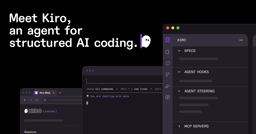
Move beyond AI coding to agentic engineering
Kiro is an agentic engineering platform that moves beyond traditional AI coding by helping developers and teams turn prompts into executable specs, validate code correctness using property-based tests, and build across large codebases with parallel agents. It solves the problem of generated code that passes unit tests but fails in production by catching edge cases through automated reasoning and behavior verification. Kiro is designed for developers, teams, and enterprises who want structured, reliable, and maintainable code—from startups to cloud architects.
Turn prompts into requirements, architectural designs, and sequenced tasks, then implement them with parallel agents to ship maintainable code that matches specifications.
Catch edge cases that pass unit tests but break in production by asserting rules that must hold across all inputs, similar to fuzz testing.
Before writing code, Kiro checks requirements for contradictions and gaps using automated reasoning techniques to ensure intent matches output.
Build across large codebases with parallel agents that learn from every session, running locally or in the cloud.
Choose the best model for every task—Anthropic Claude, open-weight models, or Auto, which picks the best model based on complexity, latency, and cost.
Run the headless CLI in CI/CD to review PRs and fix bugs without opening an editor, with hooks for automated tasks like adding tests or updating docs.
Compatible with Agent Client Protocol (ACP), AGENTS.md, Skills.md, MCP, Open VSX extensions, and over 500 popular CLIs (bash, zsh, fish).
Built and operated by AWS, offering IAM/SSO authentication, usage dashboards, cost management, IP indemnity, governance, and administration controls.
Spec-driven development is Kiro's approach to turning prompts into requirements, architectural designs, and sequenced tasks before implementing them with parallel agents, ensuring the final code matches the specification and is maintainable.
Kiro uses automated reasoning to check requirements for contradictions and gaps before coding, and then validates behavior with property-based tests that assert rules across all inputs, catching edge cases that unit tests often miss.
Kiro supports Anthropic Claude, open-weight models, and an 'Auto' mode that selects the best model for each task based on complexity, latency, and cost.
Yes, Kiro offers a headless CLI that can run in CI/CD to review pull requests, fix bugs, and run automated tasks like adding tests or updating documentation without opening an editor.
Yes, Kiro is built and operated by AWS, providing IAM/SSO authentication, usage dashboards, cost management controls, IP indemnity, governance, and administration controls suitable for enterprise-grade security and reliability.
Kiro uses a credit-based pricing model with no daily or weekly rate limits. It offers pre-paid overages for cap overages and add-on credits, ensuring predictable costs without surprise bills.